Thomas J. Watson Sr.'s and IBM's World War II Efforts
|
|
Date Published: January 1, 2024
Date Modified: July 25, 2026 |
In Father, Son and Company, Thomas J. Watson Jr. described IBM's involvement in World War II:
"Because warfare had become so big and complicated that bookkeeping had to be done right on the battlefield, the entire military was beginning to move by IBM cards. Toward the end of the war I'd land on some Pacific atoll just taken from the Japanese and find a mobile punch-card unit (Machine Records Unit - MRU) there, tabulating the payroll. (These were the invention of my brother Dick, who as a major in the army Ordnance Corps by the end of the war; it was his idea to put punch-card machines on army trucks for use in combat zones.) IBM cards kept track of bombing results, casualties, prisoners, displaced persons, and supplies. There was a punch-card record of every man drafted, and it followed him through induction, classification, training, and service, right up to his discharge.
"There were also IBM machines involved in a lot of top-secret applications. Our equipment was used to break the Japanese code before the Battle of Midway and to help in hunting down German U-boats at sea. Making machines for the armed forces and defense suppliers would have been enough to keep IBM's factories whirring at full capacity. But IBM was also called on to make ordnance-machine guns for fighter planes, infantry carbines, bombsights, gas masks, and more than thirty other war items.
"To keep up with this, Dad set up a new factory in the town of Poughkeepsie and doubled the size of our Endicott plant. By the middle of the war fully two thirds of IBM's factory capacity was devoted to ordnance work. Dad could have made tens of millions of dollars on this business, but that didn't interest him. He was very sensitive about making money from war production, both on moral grounds and out of concern for IBM's image. He didn't want the company accused of profiteering. So he had a rule that IBM could make no more than one percent profit on munitions, and IBM's annual profit for each war year stayed the same as it had been in 1940. As far as Dad's own salary went, he had a proportion of it, representing the extra wartime business, set aside in a fund for widows and orphans of IBM men killed in action."
Thomas J. Watson Jr., Father, Son & Company, 1990
The last line in this excerpt from Father, Son and Company by Watson Jr. is close to the facts but not factual and very incomplete. Watson Sr. held the corporation's annual profits to one and one-half percent. The "Widows' and Orphans' Fund" received its money from this percentage. After the war an audit did show that profits were held to one percent. As far as Watson Sr.'s "salary" it was his commissions, not his salary, that were reduced to fund the IBM Retirement Plan. Watson Jr.'s support staff should have done a little better research as this is documented quite clearly in IBM's annual reports of the day. He also fails to discuss his father's contributions during World War II such as IBM's donation of machinery and operational personnel in logistical support for organizations such as the International Red Cross (ICRC), Bundles for Britain, British-American Ambulance Corps, the Nuremberg Trials, Founder of the USO Camp Shows, and other contributions.
Follow the links below to read the results of my research into "IBM's World War II Efforts."
Peter E. Greulich, 2026
Thomas J. Watson Sr.'s and IBM's World War II Efforts
To assist the reader in understanding how critical the year 1943 was to the war effort and to set the context for these advertisements, a list of critical dates from World War II is included.
|

During WWII the "E" award was extended to embrace those plants and organizations which demonstrated excellence in building ships, weapons, and background equipment for the Navy. This is a list of the "E" awards earned by IBM's Endicott and Poughkeepsie plants: nine in all.
|

Charts are provided documenting the significant rise in IBM revenues but that profits were flat during the war years. This is what a corporation did—and corporations should do, during a time of social crisis such as a war.
An audit after the war showed profits were actually less than one percent. |

These "mobile" units which followed the troops—sometimes under fire—gathered, evaluated, and forwarded intelligence for leaders like Eisenhower and Patton to utilize. This information was a wartime advantage for the Allies.
|

"Our extensive building and expansion program to meet the demands made upon us by the government was financed entirely by the company."
Watson Sr., National Telephone Conference, October 25, 1946
|
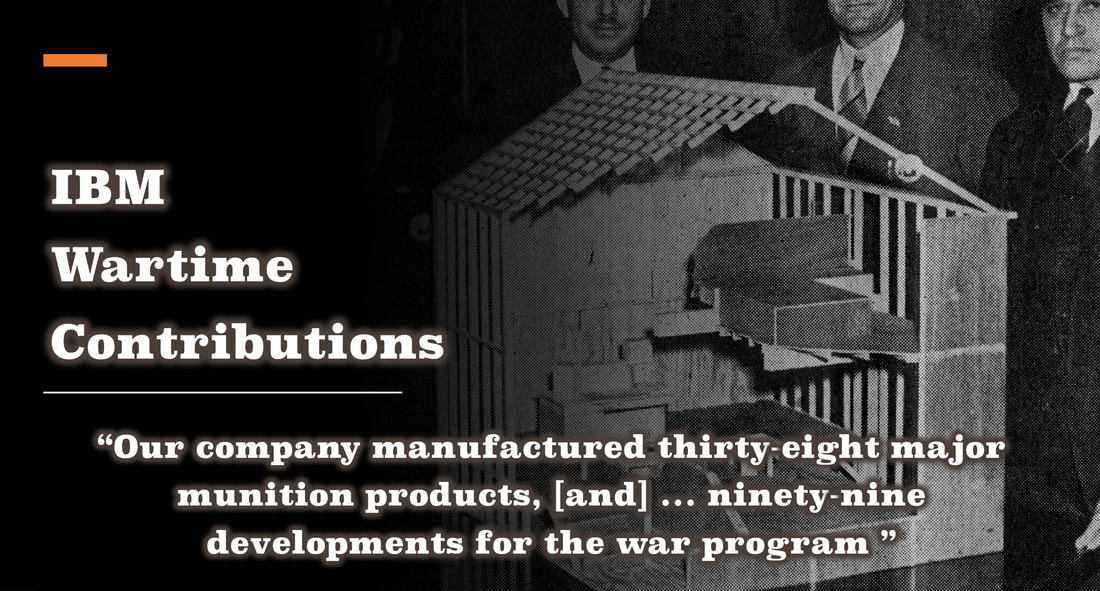
He insisted on a retroactive agreement that set his maximum share of company income to a 1939 level—a time prior to the start of World War II when IBM was receiving no revenue from government munitions.
|
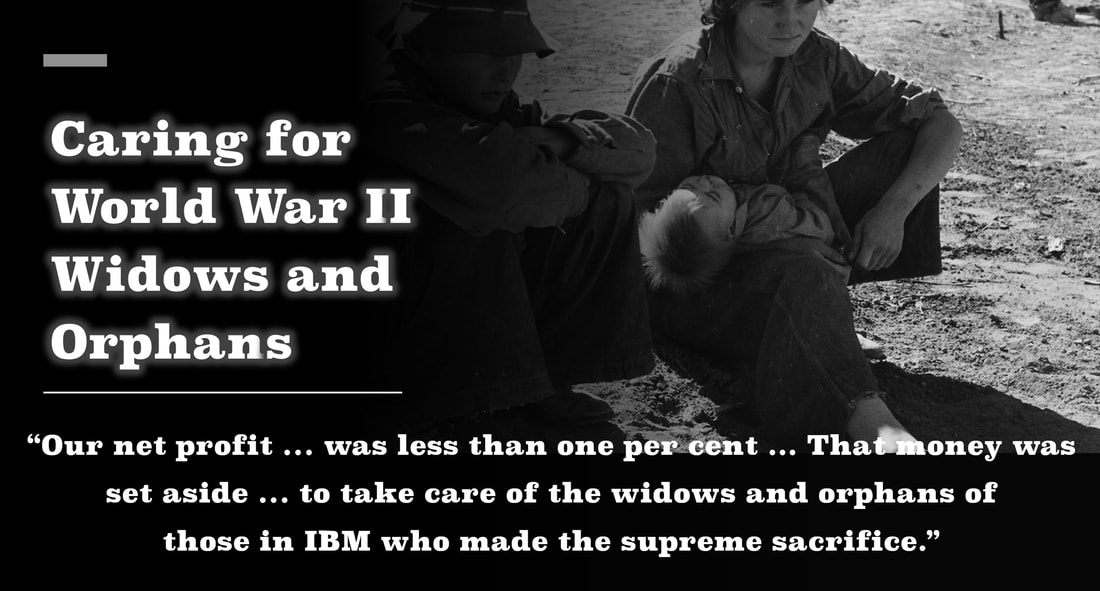
Thomas J. Watson Sr. was one of the “public officials” who signed this declaration as documented in multiple press articles dated December 15, 1944.
|

To convey the level of commitment of IBM and its chief executive officer to supporting their economic system of capitalism and their political system of democracy, two individual 1944 morale-lifting campaigns are documented in this article.
|

Additionally, IBM had 54 women in the service.
|

To convey the level of commitment of IBM and its chief executive officer to supporting their economic system of capitalism, their political system of democracy, and world peace, four 1945 IBM advertising campaigns are listed in this article.
|
